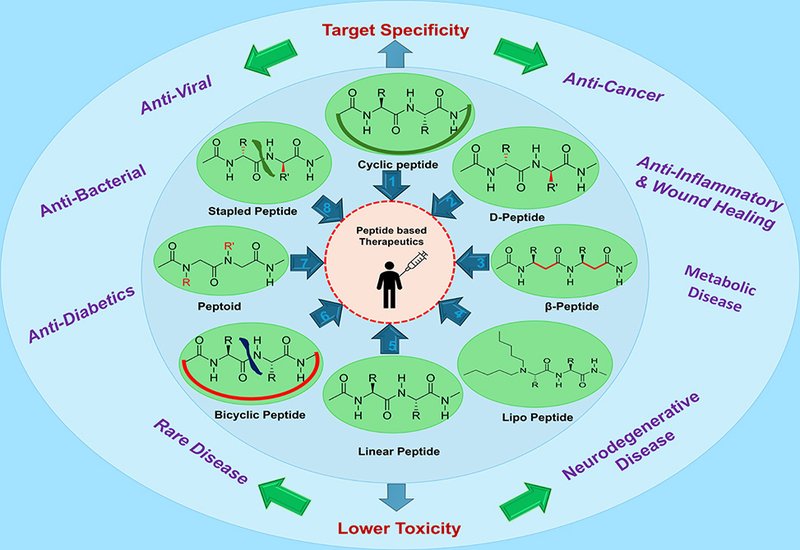
Peptides occupy a productive middle ground in the pharmacological landscape: more specific than most small molecules and easier to manufacture and modify than large biologics such as antibodies. Their clinical story began in 1921 with insulin, and more than 80 approved drugs now carry a peptide structure. Yet the class carries persistent liabilities. Proteases degrade peptides rapidly in plasma and the gut, renal clearance shortens their half-lives, and poor intestinal permeability makes oral delivery the exception rather than the rule. Closing those gaps has become one of the central problems of modern medicinal chemistry, and the pace of progress across synthesis, chemical modification, delivery, and computational design has accelerated sharply over the past decade.
Researchers in the Bhunia Lab at Cold Spring Harbor Laboratory, with co-corresponding authors Jhuma Bhadra at the Indian Association for the Cultivation of Science and Achinta Sannigrahi at the University of Texas Southwestern Medical Center, published in Biochemistry, present a comprehensive review of the field spanning synthesis strategies, peptidomimetic design, noncanonical amino acid incorporation, delivery systems, and therapeutic applications across diabetes, oncology, and infectious disease.
The review organizes chemical modification strategies around their mechanistic rationale. Backbone changes, including Cα- and Nα-methylation, β3-homo amino acid substitution, and D-amino acid replacement, disrupt enzyme recognition and extend circulating half-life. Cyclization restricts conformational entropy and raises protease resistance; the "Cy-Click" macrocyclization reported by Raj et al. exemplifies how one-pot, intramolecular chemistry can produce 12-to-24-membered rings with greater than 99% diastereoselectivity. Stapled peptides, locked into α-helical conformations by hydrocarbon bridges, gain access to intracellular protein–protein interaction targets that conventional small molecules cannot engage. Sulanemadlin, also known as ALRN-6924, a dual MDM2/MDMX inhibitor already in Phase 1 trials, illustrates the clinical translation of this approach. PEGylation and lipidation extend half-life through distinct mechanisms: the former increases hydrodynamic radius to reduce renal clearance, and the latter promotes albumin binding, as seen in liraglutide's C16 fatty acid conjugate. The review also catalogs bicyclic peptides, glycosylated and phosphorylated peptides, and peptoids, noting that cyclic peptoids show superior cell permeability independent of side-chain composition.
In the therapeutic sections, glucagon-like peptide-1 receptor agonists, GLP-1RAs, receive detailed treatment. Semaglutide's combination of amino acid substitutions and C18 fatty diacid acylation enabled not only once-weekly injection but also the first orally delivered GLP-1RA formulation, co-administered with the absorption enhancer sodium N-(8-[2-hydroxybenzoyl]amino)caprylate. Next-generation multiagonist peptides including tirzepatide, a dual GLP-1/GIP receptor agonist, and triple agonists such as retatrutide further expand the metabolic target space. In oncology, the review covers RGD-motif tumor-homing peptides, stapled peptide inhibitors of the Bcl-2 family, peptide-drug conjugates, and cancer vaccines targeting HER2, MUC1, and WT1 antigens. A forward-looking section describes a conformationally adaptive strategy in which peptides derived from chameleon sequences within the mycobacterial protein MPT63 remain disordered at physiological pH but fold into membrane-active α-helices under the acidic conditions of the tumor microenvironment, triggering pyroptotic cell death via gasdermin D activation after delivery in porous organic polymer nanocarriers. Phage display, augmented by next-generation sequencing and machine learning, is presented as the primary discovery engine for novel peptide ligands, with the identification of neuroblastoma-targeting peptides that improved survival in preclinical mouse models cited as a concrete example of its translational reach.
The review positions peptide therapeutics at an inflection point. Advanced modification chemistries have resolved many of the pharmacokinetic liabilities that historically confined peptides to injectable formats, and a clinical pipeline spanning metabolic disease, gastrointestinal disorders, and oncology reflects that progress. Looking ahead, the authors highlight artificial-intelligence-driven sequence design, genetic code expansion for noncanonical amino acid incorporation, stimuli-responsive nanocarrier systems, and conformational switch strategies as the directions most likely to extend the reach of peptide drugs into currently intractable targets, including epigenetically regulated drug-resistance mechanisms and undruggable intracellular proteins.